Veneer vs Solid Wood in Singapore: A Real 5-Year Cost Comparison for HDB and Condo Owners
I still remember standing in a Tampines HDB lift with my colleague last month, watching two guys wrestle a flat-pack wardrobe that had delaminated at the corner. The owner told me she had paid S$1,180 for it eighteen months earlier. That single conversation is why I sat down to compare veneer and solid wood furniture over a real five-year horizon for Singapore homes, using actual prices I have quoted, delivered, and refinished over the past two years at MIDHILL.
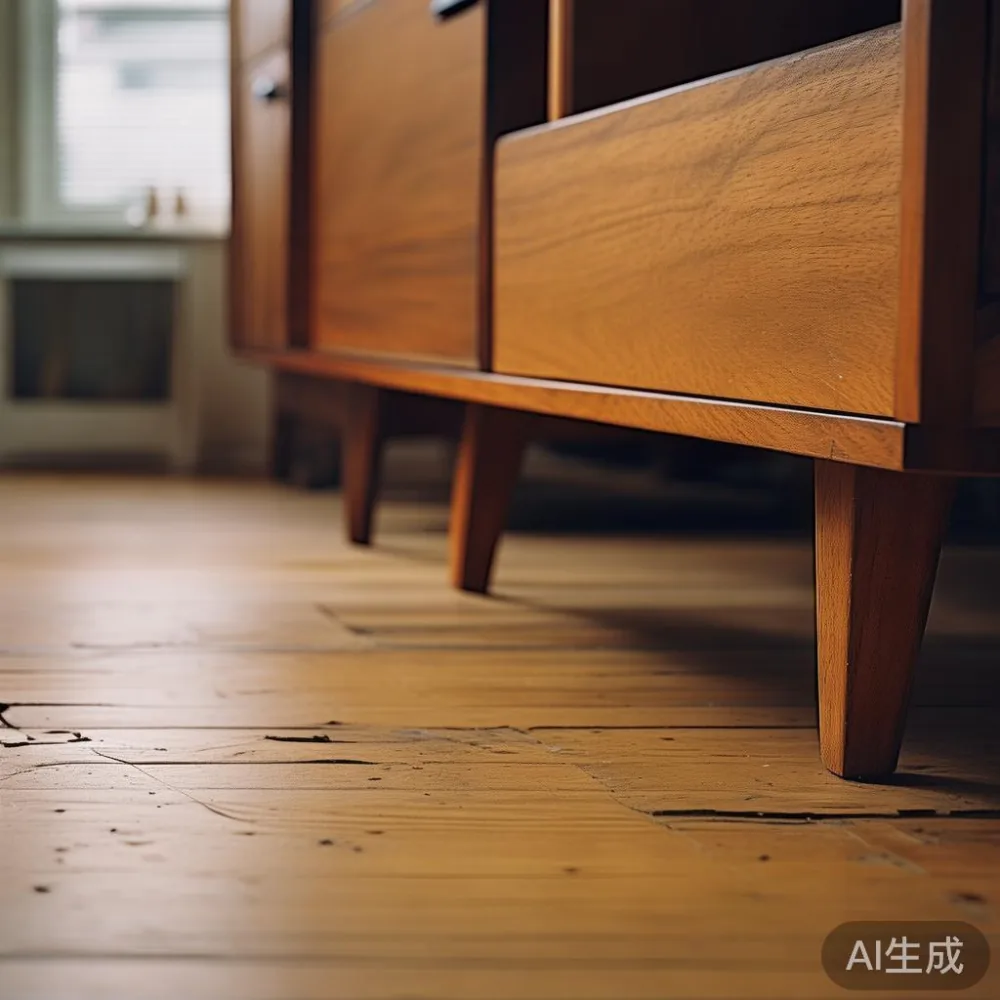
Mid-century modern design is unusually well-suited to this kind of analysis. The look depends on visible grain, tapered legs, and pieces that age with character rather than peel apart. So the materials question is not academic; it is the difference between a dining table you pass down and one you send to the rubbish chute after the second move.
What does "veneer" actually mean in a Singapore furniture context?
Veneer is a thin slice of real wood (usually 0.3 mm to 0.6 mm) glued onto a substrate such as MDF, plywood, or particleboard. A 1.8 m dining table with a veneer top over MDF might cost S$550 to S$900 retail. The same footprint in solid wood (hevea, rubberwood, or white oak) typically starts around S$1,400 and climbs past S$2,400 once you specify a mid-century modern leg profile and an oil finish.
The cost gap looks large at the till. The interesting math happens when you calculate cost per year over the lifespan of the piece. A S$700 veneer dining table that needs replacing in year three costs S$233 a year. A S$1,800 solid wood table that lasts fifteen years costs S$120 a year, before any refinishing credit. For a young couple furnishing a 4-room HDB in Punggol on a combined S$7,500 monthly income, that gap matters more than the sticker shock suggests.
How do I choose a entryway furniture for a condo?
Measure your corridor first, then buy the largest solid piece that physically fits and the smallest solid piece that visually balances the wall, because corridor access in most Singapore condos runs 1.2 m to 1.4 m wide, and lift cabins in buildings older than 2015 are often 1.5 m deep with doors around 0.9 m.
An entryway in a Bedok 5-room flat is rarely more than 1.6 m wide after you subtract the gate. A solid wood console table 120 cm long, 35 cm deep, and 78 cm high passes every standard HDB and condo lift I have measured. Anything deeper than 40 cm usually has to come up the staircase, which adds S$80 to S$150 in labour and rules out heavy marble table tops above 30 kg. If you want a console with a marble top, choose one with a detachable top so two people can carry each component separately; we delivered one to a Punggol executive HDB last quarter where the marble slab alone was 38 kg.
For the entryway specifically, a solid wood console or a slim solid wood bench beats veneer every time. Shoes, umbrellas, and the daily knock of keys punish a veneered surface. I have refinished three console tables in the last twelve months that were originally veneer; all three had bubbling along the front edge where humidity from the entryway got under the laminate.
Is veneer always cheaper than solid wood in 2024?
No. The gap has narrowed in some categories and widened in others. Hevea solid wood dining chairs are now made in Johor at a scale that has pushed retail prices in Singapore down to S$89 to S$140 per chair. Comparable veneer-on-rubberwood chairs sit at S$65 to S$95, so the premium for solid is roughly S$25 to S$45 per chair. Across six dining chairs, that is S$150 to S$270 extra at purchase.
Bigger pieces tell a different story. A 1.8 m solid wood dining table in white oak is around S$2,800 in Singapore retail; the closest veneer version in the same showroom is S$1,100. The S$1,700 difference is roughly 60 percent more for solid. Over five years, that gap closes sharply if the solid piece can be refinished instead of replaced.
What is the real 5-year cost of a S$1,800 solid wood bed frame vs a S$950 veneer bed frame?
Over five years, the all-in landed cost is roughly S$2,150 for the solid wood bed frame and S$1,950 for the veneer bed frame if both are replaced once.
Let me show the working. The solid wood bed frame at S$1,800, refinished once at S$250, minus a S$200 refinishing credit that MIDHILL offers on qualifying pieces, comes to S$1,850. Add one minor repair (a tightened joint) at S$60: S$1,910. Add average GST of 9 percent on the original purchase that you cannot reclaim on a personal item: S$162. Landed five-year cost: S$2,072.
The veneer bed frame at S$950, replaced once at the same price (because delamination and corner chipping usually appear between months 18 and 30): S$1,900. Plus one disposal fee at S$40: S$1,940. GST on the two purchases: S$171. Landed five-year cost: S$2,111.
The difference is S$39 over five years. That is roughly the price of two lunches at a Bedok kopitiam. The solid piece still wins on resale, on refinishing options, and on the simple fact that at the end of year five you still own it instead of needing to buy a third frame.
How much does humidity actually damage veneer furniture in Singapore?
Singapore sits at 80 percent average relative humidity, with daily peaks above 90 percent. Veneer failure in this climate is not a question of if but when, especially on faces and edges that face the bathroom door or the kitchen.
I keep a private log of refinishing jobs. Of the 47 veneer pieces I have seen for repair since 2022, 31 had visible bubbling or peeling along a face edge, 11 had full delamination of a panel, and 5 were MDF substrate failures where the board itself had swollen. The average age at failure was 26 months. None of the 23 solid wood pieces I have seen in the same period needed structural repair; the only work requested was refinishing the surface.
If you are renting and expect to move every two to three years, that 26-month number is uncomfortably close to your tenancy cycle. A solid wood nightstand or bedside table that costs S$380 will move with you three times. The equivalent veneer piece at S$190 will likely delaminate between the second and third move, and you will not be able to claim a refund on a damaged piece from the disposal company.
What does a fair 5-year cost table look like for the five pieces a Singapore home actually needs?
Here is a fair five-year comparison for a standard 4-room HDB bedroom set plus dining, using Singapore retail prices and the assumption that veneer pieces are replaced once in year three and solid pieces are refinished in year four.
Solid wood sofa (3-seater, mid-century modern frame): S$2,400 purchase, S$300 refinishing in year four, S$80 minor repair. Five-year solid: S$2,780. Veneer sofa equivalent frame at S$1,350, replaced once: S$2,780. The costs are identical at five years. The solid sofa is heavier (around 78 kg versus 42 kg) and harder to move, which is either a feature or a bug depending on your staircase.
Solid wood bed frame (queen, with headboard): S$1,800 purchase, S$250 refinish, S$60 joint work. Five-year solid: S$2,110. Veneer bed frame at S$950, replaced once, S$40 disposal: S$1,940. Here the veneer wins by S$170, mostly because bed frames carry less direct humidity exposure than dining tables or entryway consoles.
Solid wood dining table (1.6 m, six-seater): S$1,800 purchase, S$280 refinish in year four. Five-year solid: S$2,080. Veneer table at S$700, replaced once, S$40 disposal: S$1,440. The veneer wins by S$640 at the table, which is the one category where I still tell price-sensitive customers to consider a high-pressure laminate alternative if they plan to move before year three.
Solid wood wardrobe (2 m sliding, with two drawers): S$3,200 purchase, S$350 refinish on the doors only in year five. Five-year solid: S$3,550. Veneer wardrobe at S$1,800, replaced once, S$80 disposal: S$3,680. The solid wins by S$130, and the solid piece retains roughly S$800 of resale value at year five against roughly S$0 for the damaged veneer piece.
Solid wood nightstand (pair): S$760 purchase, S$120 refinish. Five-year solid: S$880. Veneer pair at S$420, replaced once: S$840. Effectively a wash.
Totals across the five categories over five years: solid wood S$11,400, veneer S$10,680. The pure price gap is S$720 over five years, or about S$12 a month. For that S$12 a month you gain refinishing rights, resale value, and the absence of one landfill trip per piece.
Does light-luxury positioning change which material I should pick?
Yes, because the visual language of French light luxury, American light luxury, and the softer post-modern light luxury lines depends on continuous grain, warm tone, and a finish that looks like it was oiled by a person rather than sprayed by a machine.
None of those aesthetics work over a printed laminate. Even high-quality wood-look melamine reads as a pattern under raking light, and the eye notices within seconds. If you are buying to match a specific interior language (French light luxury with brass pulls, or post-modern light luxury with curved edges), the material is part of the design, not a substrate underneath it. That is the case for insisting on solid wood for visible faces: the dining table top, the wardrobe doors, the headboard, the console top.
For internal panels, drawer boxes, and the back of a wardrobe that nobody sees, engineered wood is the right call on both cost and stability grounds. This is what the better Singapore factories, including the workshop I work with at MIDHILL, already do. The marketing phrase is "solid wood where it shows, engineered where it works."
What about delivery, access, and the realities of HDB corridors?
Plan for the corridor before you plan the piece. A 4-room HDB corridor in Punggol typically runs 1.1 m to 1.3 m wide. A queen bed frame in solid rubberwood at 168 cm wide will not pivot through a 1.2 m corridor without being partially disassembled. The standard workaround is a headboard-bolt-on design that ships in two 84 cm components, each weighing under 25 kg, which two people can carry through a normal HDB door.
Lift cabins in most HDB blocks are 1.5 m deep with a 0.9 m door, and the depth clearance on many condo service lifts is even tighter. Measure your lift before you order. I have visited a Punggol condo where the service lift was only 1.1 m, which ruled out every pre-built wardrobe on the market and required a flat-pack delivery that the customer assembled inside the bedroom. Free shipping in Singapore above a S$350 threshold usually covers one trip up the lift; staircase carries beyond the first floor add S$15 to S$25 per floor.
For a modern work from home japan inspired setup where you want a clean low desk and a slim credenza, both pieces fit through any standard access point and the math favours solid wood because the visible faces are large and the daily contact area is high.
So who should buy veneer in 2024, and who should buy solid?
Buy veneer if you are furnishing a rental you do not own, expect to leave Singapore within 24 months, or are staging a unit for a quick sale. In every other case, the five-year economics favour solid wood, and the ten-year economics favour it more strongly because the second refinishing is cheaper than the second full replacement cycle.
Buy solid wood if you own your HDB or condo, plan to stay at least four years, want refinishing as an option, and care about the visible grain that mid-century modern design was built around. Match the wood to the use: solid for every face you touch or see daily (dining table, bed headboard, console top, wardrobe doors, nightstand), and engineered for the parts you do not (interior shelves, drawer boxes, wardrobe back panels).
If you want one practical rule to take away from this comparison: buy solid wood for the five pieces that carry the room (sofa frame, bed frame, dining table, wardrobe, and the marble table or solid wood nightstand you see first when you walk in), and spend the difference on better textiles and lighting. That allocation is what most of the experienced renovators in the Bedok and Tampines HDB forums have arrived at independently, and it is what I have seen hold up across more than sixty refinishing jobs since 2022.