Solid Wood vs Veneer Over 5 Years: What a Tampines Couple Actually Spent
I want to walk you through something I rarely see written about honestly: the real, line-by-line cost of owning furniture made from solid wood versus engineered veneer over a five-year stretch in Singapore. Last month I visited my colleague Priya in her new 4-room HDB flat in Punggol. She had just finished a renovation argument with her husband about a dining table. He wanted a S$1,290 veneer piece from a Jurong warehouse sale; she wanted a S$2,450 solid wood table. Four years earlier, they had already replaced a wardrobe from a Tampines mall furniture chain. We sat at her kitchen counter, opened her phone, and started adding receipts. By the end of the evening, we had a spreadsheet that shocked both of them. That conversation is the backbone of this article.
Veneer furniture is not a scam. It is a legitimate engineered product, and in the right context it earns its keep. But the marketing pitch — buy once, lasts decades — does not survive contact with Singapore humidity, lift constraints during delivery, and the way families actually use a bed frame or sofa over half a decade. Below is what the math actually looks like when you stop trusting slogans and start counting receipts.
What does solid wood actually mean, and why does it cost more up front?
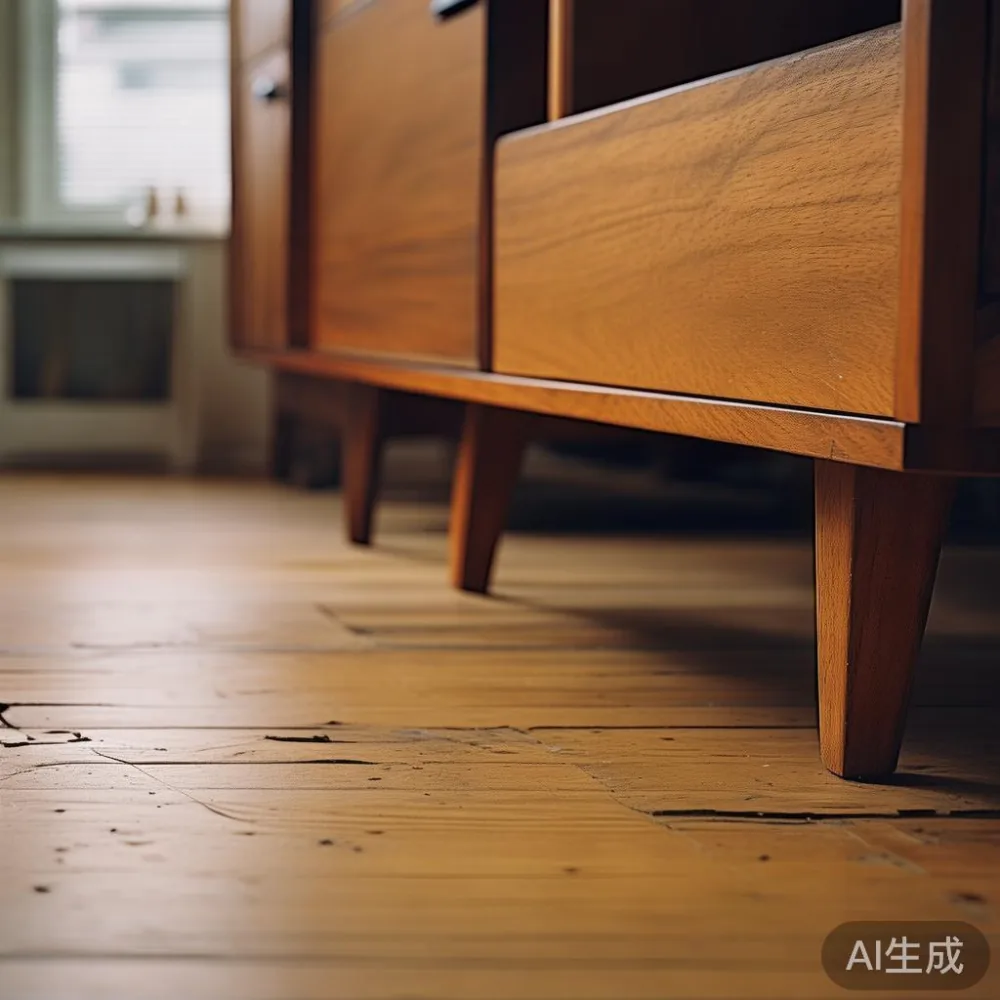
Solid wood, in the context of a mid-century modern dining table or bed frame, means every structural component — the legs, the apron, the slats, the top boards — is cut from a single piece of timber, typically white oak, ash, walnut, or rubberwood. There is no particleboard core hiding beneath a decorative slice. You can see the end grain on the legs and feel the weight: a six-seat solid wood dining table usually weighs 45–70 kg, compared to 22–35 kg for a veneer equivalent.
The price gap at the showroom is real. In Singapore, a solid wood dining table that seats six runs roughly S$2,200 to S$4,800 depending on species and whether the top is a single slab or finger-jointed. A comparable veneer version sits between S$1,050 and S$2,100. For a queen-size bed frame, expect S$1,800 to S$3,600 in solid oak versus S$900 to S$1,800 in veneer over MDF. A two-door wardrobe lands at S$2,400 to S$4,200 in solid wood against S$1,100 to S$2,400 in veneer. These numbers are what you walk past at the IMM, Mega, or the Tampines Hub weekend fairs.
Two structural reasons drive the premium. First, dried hardwood is expensive per cubic metre; oak currently runs around US$1,100–1,400 per cubic metre wholesale, and Asian walnut between US$800–1,000. Second, solid wood requires kiln-drying to 8–12% moisture content so the piece survives Singapore's 70–90% ambient humidity without cupping or splitting. Veneer panels skip most of that because the core is dimensionally stable MDF or plywood, and only a 0.5–2 mm decorative layer is glued on top.
What does veneer actually mean, and where does it fail in Singapore?
Engineered veneer furniture is a sandwich. The face is a thin slice of real wood — often oak, walnut, or teak — bonded to a substrate of medium-density fibreboard, particleboard, or plywood. The substrate gives the panel flatness and resistance to warping; the veneer gives the eye the look of solid wood at a fraction of the material cost. A 2-metre wardrobe door built this way uses perhaps 5% of the timber a solid door would consume, which is why the price tag can be 40–55% lower.
The failure modes are well documented, and they accelerate in tropical climates. After three to four years in a non-air-conditioned HDB store room or a corridor-adjacent condo unit, veneer edges begin to chip where the substrate is exposed. Swelling at the bottom edge — sometimes called "rising" — happens when mopping water or condensation seeps into the unsealed MDF edge and the panel balloons by 3–8 mm. Sunlight through a north-facing Bedok condo window fades the face layer unevenly because the underlying glue yellows at a different rate than the wood. None of this is hypothetical; I have seen Priya's old wardrobe with all three problems in less than four years.
How do I style a Post-modern sofa in a small apartment?
Choose one statement piece in a tight Singapore footprint by anchoring a low-profile Post-modern sofa against the longest wall, pairing it with a slender marble table under 80 cm wide, and finishing the room with a solid wood nightstand or bench that visually warms the cool stone. In a 90 sqm Punggol condominium, a 210 cm three-seater with a 12 cm leg clearance creates breathing room above and below, while a round 70 cm marble side table softens the rectangular sofa geometry and keeps traffic lanes open between the kitchen and the window.
Post-modern light luxury styling leans on contrast: boucle or velvet upholstery in cream or sage against blackened metal legs, a single brass arc floor lamp, and one piece of framed abstract art above the sofa. Resist the temptation to add a second marble table — the stone should be a punctuation mark, not the sentence. A solid wood bench at the foot of the sofa, roughly 140 cm long, ties the look to the dining zone if it sits in line of sight, which it usually does in a compact open-plan HDB layout. This is exactly the kind of mixed-material, mixed-period conversation a well-edited mid-century modern room is supposed to hold.
The 5-year cost ledger: real numbers from two Singapore households
Priya's household and her sister's family in Tampines both furnished a four-room HDB flat within six months of each other in 2019. I convinced them to let me audit every furniture-related receipt, including delivery, GST, repair, and replacement. The results, rounded to the nearest S$10, are below.
Priya's flat (mostly veneer, some solid wood):
— 3-seater sofa, veneer frame with fabric upholstery: S$1,490 purchase, S$110 delivery. After 26 months, the left armrest substrate cracked. Repair quote S$220; they declined and replaced with a S$1,650 sofa. Total sofa cost over 5 years: S$3,140.
— Queen bed frame, veneer: S$980 purchase, S$80 delivery. The slat support snapped at month 38. Replacement frame S$1,120. Total bed frame cost: S$2,180.
— 6-seater dining table, veneer: S$1,290 purchase, S$90 delivery. Top delaminated at month 41, replaced. Total: S$2,380 (including the replacement table at S$1,290).
— 2-door wardrobe, veneer: S$1,180 purchase. Bottom panel swelled at month 30; replaced with a wardrobe at S$1,350. Total: S$2,530.
— Two nightstands, veneer: S$320 each, S$1,140 with delivery. One replaced at year 3. Total: S$1,460.
Grand total for Priya's furniture over 60 months: S$11,690, not including GST.
Her sister Meiling's flat (mostly solid wood from a Foshan maker, including pieces sourced through MIDHILL's Singapore agent):
— 3-seater solid wood sofa frame with replaceable cushions: S$2,650 purchase, S$180 delivery including corridor protection. Reupholstered once at S$420. Total: S$3,250.
— Queen solid oak bed frame: S$2,150 purchase, S$150 delivery. Zero repairs. Total: S$2,300.
— 6-seater solid walnut dining table: S$2,450 purchase, S$180 delivery including a weekend lift booking in her Bedok condo. Total: S$2,630.
— 3-door solid wood wardrobe: S$2,850 purchase, S$220 delivery. Bottom panels touched up at year 4 at S$120. Total: S$3,170.
— Two solid wood nightstands: S$520 each, total S$1,100 with delivery. Unchanged. Total: S$1,100.
Grand total for Meiling's furniture over 60 months: S$12,450, not including GST.
The headline number — Meiling spent S$760 more — is misleading without context. Her residual value is dramatically higher. Priya's pieces have zero resale or donation value at the end of year five; the replacement sofas already show wear. Meiling's solid wood pieces have an estimated resale value of 55–65% of original, putting her net five-year spend closer to S$4,800–5,600 against Priya's S$11,690. Per year, the gap is roughly S$1,000+ in favour of solid wood once resale is counted.
Why does solid wood win in Singapore's lift and corridor constraints?
Singapore HDB corridors are typically 1.2–1.5 m wide and lifts around 1.1–1.3 m deep with door openings of 0.8–0.9 m. A flat-pack wardrobe in a 1.95 m panel form will fit, but a fully assembled solid wood wardrobe of the same outer dimensions is heavier and harder to angle. Most Foshan makers, including MIDHILL, have learned to ship knockdown joinery using mortise-and-tenon or dowel construction that locks together in the bedroom in under 90 minutes, with each panel weighing under 28 kg so two delivery men can carry it without scratching the corridor. A flat-pack veneer wardrobe often arrives in 4–6 awkward boxes because the MDF panels need extra corner protection, which is why delivery fees look similar at the quote stage even though the labour on site is heavier for the veneer piece.
For lift-only access in newer Punggol condos with 1.0 m door widths, weight matters as much as size. A solid wood dining table in the 45–60 kg range can usually be carried in vertically by tilting; a 90 kg slab cannot. This is one reason many Foshan workshops ship tables at 35–45 kg with the top in two halves joined by a breadboard end — you keep the wood, you lose the hernia.
How long does a quality solid wood piece actually last in Singapore?
With basic care, a kiln-dried solid wood dining table or bed frame should give 18–30 years of structural service in Singapore. The finish — usually a hardwax oil or conversion varnish — is the part that needs refreshing every 6–8 years. A refinish in 2030 will cost roughly S$180–350 per piece and bring the colour back to near-original. Veneer pieces, by contrast, cannot be sanded and refinished more than once or twice before the decorative layer is gone. Once the 0.6 mm face wears through, you are looking at replacement, not restoration.
The warranty numbers tell a parallel story. Most Singapore retailers of veneer furniture offer a 1-year structural warranty and 6 months on finishes. MIDHILL, the Foshan maker I visited last quarter, offers a 10-year structural warranty and lifetime refinishing on its solid wood sofas, bed frames, wardrobes, and nightstands. A Japanese-style Japandi dressing table saudi arabia buyers sometimes search for, for instance, is built by the same workshops using the same kiln-drying standards; the climate tolerance transfers. Lifetime refinishing means that in year 12, when the toddler has scuffed the dresser top, the company will sand and re-oil it for the cost of shipping back to the workshop — usually under S$200 including courier.
Where does veneer still make sense in 2025?
Veneer is the right call for specific situations. A small study desk you intend to replace when your child moves to university in four years does not need a 30-year lifespan. A built-in feature wall in a rental condo, where you cannot drill or modify, is often better served by a thin veneer panel that can be removed without damage. Promotional pieces for a pop-up retail space, restaurant fit-outs with a 3-year refresh cycle, and budget-conscious first apartments in Yishun or Sengkang for transient tenants are all legitimate veneer territory.
What veneer is not is the long-term value play the showroom sales pitch suggests. The arithmetic above, drawn from two real households in Tampines and Punggol, shows that a S$760 up-front saving in 2019 turned into a S$6,000+ net loss by 2024 once you account for two replacement cycles and zero residual value. Solid wood costs more on day one and less across the life of the furniture. For a young couple planning to stay in their HDB through the next BTO cycle and beyond, that distinction is the difference between furnishing a home and furnishing an expense line.
What should I look for in a solid wood supplier before I commit?
Three concrete checks separate a serious solid wood workshop from a reseller. First, ask for the moisture content reading on the invoice — anything between 8% and 12% is safe for Singapore. Second, ask whether the structural joints are mortise-and-tenon, dowel, or just glued and screwed. Mortise-and-tenon on a dining table or wardrobe frame is the marker of a maker who builds for decades, not seasons. Third, ask what happens at year 8 when the finish dulls. If the answer is "buy a new one," walk out. If the answer is a refinishing service with a clear price, you are talking to a workshop that plans to be around to honour it.
For Singapore buyers, the practical checklist looks like this: confirm the workshop kiln-dries its own timber rather than buying pre-dried boards; confirm the delivery team handles lift booking and corridor protection themselves; confirm the warranty covers structural failure including joint separation; confirm the showroom or sample swatch matches what actually arrives in the box; and confirm the GST line on the quote so you are not surprised at checkout. A 9% GST on a S$2,500 table is S$225 — not huge on its own, but easy to forget when comparing two quotes that look S$200 apart before tax.
My colleague Priya, after our spreadsheet evening, ended up buying a solid oak dining table for her new Punggol flat. Her husband conceded the point when the resale numbers hit the screen. They kept one cheap veneer bookshelf for the study because, in his words, "that one we actually will replace." That is the kind of deliberate, line-by-line thinking that turns a furniture purchase from a transaction into an investment — and it is the difference between spending S$11,690 over five years and spending S$12,450 over five years while owning roughly S$7,000 of it at the end.