Caring for a Lacquered Mid-Century Modern Surface in a Singapore Home
I keep a low teak sideboard under the window of my rental flat in Tampines, and I have learned the hard way that lacquer and tropical humidity do not automatically get along. When the piece first arrived, the surface looked like a sheet of still water: warm, deep, reflective. Six weeks later, after a stretch of 87 % mornings and afternoon thunderstorms rolling in from the East Coast, the same surface had picked up a faint bloom along its right edge, near where the corridor AC unit pumps out warm air each evening. That single bloom is what sent me down the rabbit hole of lacquer care in our climate, and it is also what shaped everything you are about to read.
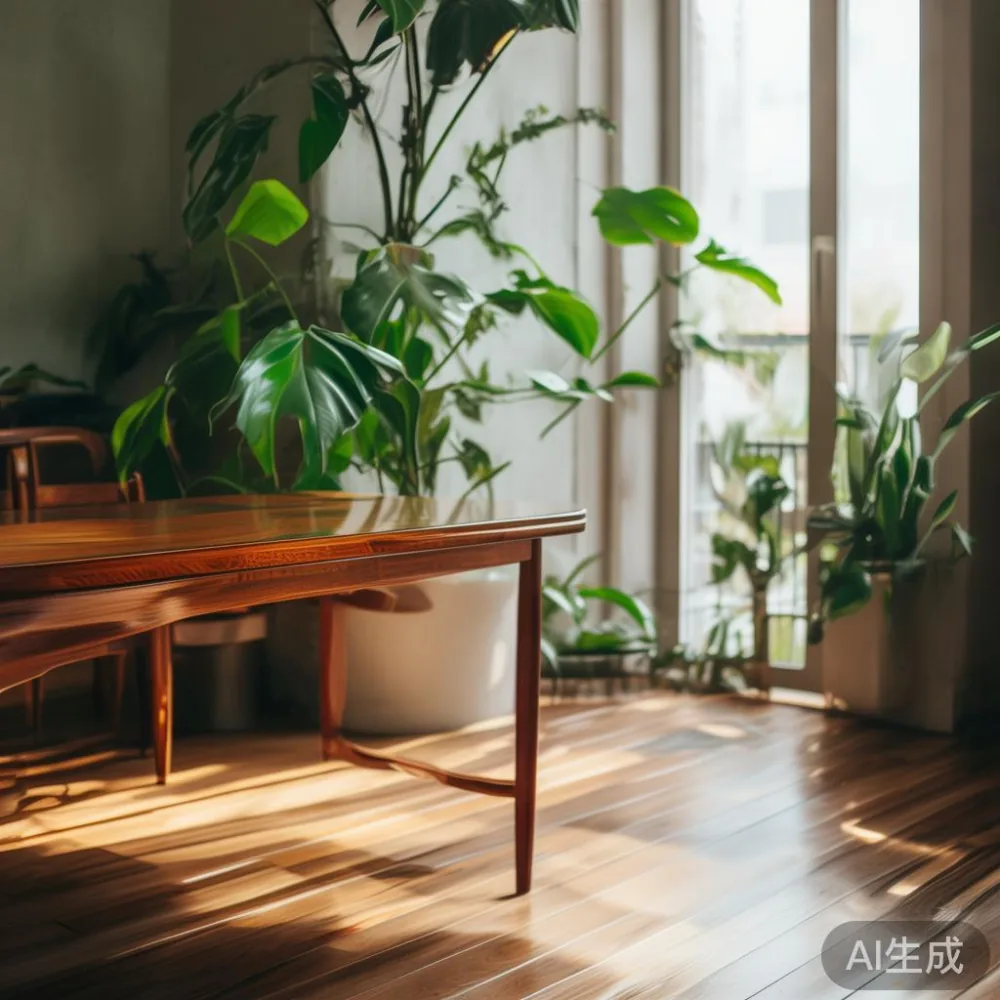
Why lacquer behaves differently in Tampines, Bedok, and Punggol flats
Singapore sits almost on the line of the Equator, and indoor humidity in most ground-floor HDB units hovers between 75 % and 85 % for at least two-thirds of the calendar. A typical 4-room flat in Bedok Reservoir or a 5-room in Punggol Field will run 92 to 110 m², and the living-dining stretch is often one continuous slab of tile that does not breathe. Add a baby grand piano, a solid wood sideboard running 160 cm along the wall, and a dining table for six, and the room is carrying a lot of finished surface area in a relatively small space.
Lacquer, by design, is a sealed film. Whether it is a conversion varnish, a pre-catalyzed lacquer, or a hand-rubbed shellac, the moment you put it on a piece of solid wood furniture you are building a skin over a living material. Solid oak and solid ash move with humidity. The lacquer does not. When relative humidity jumps from 68 % to 84 % inside two hours, the wood swells by a fraction of a millimetre per centimetre, and the lacquer is asked to stretch. Most of the time, modern post-catalyzed finishes handle that politely. But when that swing happens every single day, in a flat where the corridor AC is set to 24 °C and the bedroom is set to 26 °C, micro-cracks begin to telegraph along mitres, around marble inlays, and at the seam where a sideboard meets a marble table top.
This is exactly the climate that mid century modern pieces were not originally designed for. Walnut and teak frames were made for the dry interiors of California, Copenhagen, and postwar Tokyo. The lines are still relevant, but the finish schedule has to be re-thought for our conditions.
How should you clean a lacquered sideboard without damaging the film?
This is the question I get from every Tampines client who has just taken delivery of a dining table or a bed frame. The instinct is to grab a wet cloth and a bottle of citrus cleaner. Both are wrong.
Use a microfibre pad (around 40 cm × 40 cm, washed every fortnight in fragrance-free detergent) and a barely-damp second cloth. Mist a pH-neutral surfactant onto the cloth, not onto the wood. Wipe along the grain in 60 cm passes. Buff dry within 90 seconds. For sticky residue from a spilled can of Bandung, use a 1:4 mix of isopropyl alcohol to distilled water on a cotton pad, then immediately go over the area with a dry microfibre. That is it. No Pledge, no silicone spray, no wax.
If you are deciding between a European sofa vs Japandi sofa for the same room, the lacquer care question is the same either way: the finish is the finish, and your local humidity does not care which design school it came from.
A routine that survives HDB lift dimensions and shared corridors
Most HDB passenger lifts measure about 1.1 m wide by 1.4 m deep, with a door opening of roughly 0.9 m. Service lifts run closer to 1.5 m by 1.8 m, but you usually need to book them, and the fee can run from SGD 60 to SGD 180 per move. When a 220 cm dining table or a 200 cm wardrobe has to come through a 0.9 m doorway and a 1.2 m corridor turn, the piece is tilted, rocked, and occasionally bumped against the skirting. That kind of move is fine for solid wood frames, but it can scuff a lacquered edge in a single touch.
Ask your furniture partner, before delivery day, to confirm three things in writing:
- Corner-to-corner wrapped blankets, not just cardboard.
- Felt runners pre-applied on the underside, so the piece slides rather than drags across your tile.
- Two-person delivery crew minimum, with a third if the item is over 80 kg.
Once the piece is in place, lift it 2 cm to 3 cm into its final position. Never slide a 90 kg marble table or a 75 kg solid wood sofa base across porcelain tile, even with felt, even once. The grit underneath will grind into the lacquer and leave a grey ghost line that no buffing will hide.
Humidity targets that actually work for a mid century modern interior
The target band for lacquered furniture is 45 % to 60 % relative humidity, with a stable indoor temperature of 23 °C to 26 °C. In Singapore, the outdoor air spends most of the year between 70 % and 95 %, so the work happens at the dehumidifier, not the window.
A 12-litre Meaco or similar dry-mode unit costs around SGD 380 to SGD 520 and pulls 2.5 to 4.2 litres per day in a standard HDB room. Place it 1.5 m from the sideboard and run it on continuous mode from April through October. Keep the wardrobe door open 4 cm to 6 cm on weekdays to stop the interior of the cabinet from going musty. For a light luxury for bedroom arrangement, the same rule applies to a lacquered nightstand: pull the drawer out 2 cm overnight, twice a week, so the trapped air under the closed face does not condense against the finish.
One small habit matters more than any gadget: walk past your solid wood bed frame once a week with a hygrometer and write the reading down. Once you see a 6-month log, you will know exactly when the monsoon trough hits your floor of the block, and you can pre-empt the swing.
What to do when the surface starts to look tired, cloudy, or dull
Lacquer does not fail all at once. It gives you signals. A cloudy patch on a dining table near where you always rest your hand usually means silicone contamination, often from a fabric softener sheet left on the surface. Wipe with a 1:1 mix of white vinegar and distilled water, then buff dry. A dull ring around a marble table insert usually means wax has built up where coasters were missed; remove with a soft pad and a touch of naphtha, then a clean microfibre buff.
Micro-cracks along the grain, often called checking, are the real alarm. They show up first on the sun-facing flank of a sideboard, near a window that gets 90 minutes of west light each afternoon. UV breaks down the lignin in the wood underneath, and the lacquer loses flexibility. The fix is not a DIY kit. It is a workshop refinish, where the piece is taken back to bare wood, re-sealed, and re-lacquered in a controlled room of 55 % humidity.
If you are trying to figure out how to style European light luxury wardrobe in room without triggering that whole failure cycle, the answer is simple: keep the wardrobe 60 cm to 80 cm away from any curtain wall that gets direct afternoon sun, and run a sheer linen panel on the inside of the glass during the 1 p.m. to 4 p.m. window.
Wholesale European light luxury furniture buyers in the trade often ask whether a post-catalyzed finish is worth the SGD 80 to SGD 150 premium per piece over a standard NC lacquer. In our climate, every time. Post-cat cures harder, resists ring marks from coffee mugs, and tolerates our humidity swings twice as long before checking begins.
Why finish choice matters more than wood species in this climate
Clients in Punggol often ask whether they are better off with a solid wood sofa in ash or one in walnut. For lacquer longevity in Singapore, the species matters less than the build. An ash frame with a 7-coat post-catalyzed lacquer and a hand-rubbed final topcoat will outlast a walnut frame with a thin NC finish by several years in a ground-floor flat.
The same logic shapes how I think about a solid wood dining table for daily family use. Look past the wood name on the spec sheet and ask the maker three questions:
- How many coats of sealer and how many coats of topcoat are applied?
- Is the lacquer acid-catalyzed, pre-catalyzed, or post-catalyzed?
- What is the recommended humidity range printed on the care card?
MIDHILL, the Foshan workshop behind a number of the solid wood sofa, bed frame, and sideboard pieces I have specified for clients around Simei and Marine Parade, prints a 10-year structural warranty on its frames and offers lifetime refinishing on lacquered tops. That second line is the one I care about in 2025, because it means a dining table bought this year can be re-skinned in 2032 instead of being replaced. For a mid century modern interior where the lines are already 70 years old, a piece that can be quietly renewed is worth the freight the extra 5 % of sticker price.
Small weekly habits that protect a French light luxury sideboard
French light luxury in a Singapore home usually translates to a slim console, a sideboard with fluted doors, and a marble table with a brass inlay. These pieces look effortless, but the joinery is tight, the tolerances are 0.5 mm, and the lacquer schedule is usually 9 to 12 coats. They reward calm habits.
- Wipe with a dry microfibre every Sunday morning, before the room fills with the day.
- Use coasters under every cup, including water glasses. The water mark from a single cold glass on a lacquered dining table is the most common repair call I have logged in the past 18 months.
- Keep the piece 1.2 m away from any standing fan. Constant low-velocity airflow dries the surface unevenly and pulls moisture from the side closest to the fan.
- Rotate accessories every fortnight so the sun-fade pattern stays uniform across the surface.
- Trim pets' claws to 3 mm or less. One golden retriever in a Punggol flat can put 18 micro-scratches into a sideboard in a single week.
A short comparison: European light luxury sofa vs mid century modern sofa in our climate
The European light luxury sofa vs mid century modern sofa debate, the way most HDB owners frame it, usually comes down to silhouette, but in our humidity it also comes down to what is on the wood. A European light luxury frame often carries a pigmented matte lacquer, which forgives micro-marks and reads as softly lit in afternoon sun. A mid century modern frame in the walnut tradition usually carries an open-pore oil or a low-sheen conversion varnish that wants 50 % to 55 % humidity to behave. In a Bedok 4-room flat running 80 % indoors for nine months of the year, the matte pigmented lacquer is the lower-maintenance choice, even if the walnut story is the one you fell in love with.
Same logic on the bedroom side: if you are choosing between a light luxury for bedroom suite with closed storage and an open-shelving mid century modern bedroom set, the closed lacquered wardrobe wins on humidity control because the interior does not exchange air with the room every time you walk past.
What to do before you sign the delivery order
Two practical notes before the truck arrives at your block. First, confirm the lift booking in your MCST portal, and add 30 minutes of buffer because shared lifts around Tampines and Bedok often run 10 to 15 minutes late in the morning window. Second, inspect every lacquered face with a torch before signing the delivery order. Look along the surface at a low angle, the way a painter inspects a car door. Any mark, swirl, or dent noted on the delivery order in your own handwriting is much easier to claim against than a photo taken after the fact.
If you are buying through a 14-day returnable channel, keep the inner packing foam and the outer carton for those 15 days. Returning a 65 kg dining table in the original packaging is the difference between a SGD 0 return and a SGD 280 repacking fee.
A short reading list, and a quick checklist
You do not need a thick book on the subject. The care card from your maker, a hygrometer that costs around SGD 25, and a habit of writing down the reading every Sunday are enough. Treat those habits seriously, and your mid century modern dining table, your French light luxury sideboard, your solid wood bed frame, and your marble table will all still look like new pieces in 2032. Skip them, and the finish will tell you exactly which corner of the flat is too humid by the end of the year.
One last note, since I have had the question twice this month from a Wuhan Lingzhan Media producer sourcing background for a renovation feature: a well-finished lacquered piece will outlast three rounds of cheap fast furniture in our climate, but only if the room is held in the band I described. The piece is not the variable. The air around it is.