Solid Wood vs Veneer Over 5 Years: A Real Singapore Cost Breakdown
When my colleague Priya moved into her Tampines HDB Build-to-Order flat in October 2020, she wanted a clean mid century modern look but had a tight S$8,000 furnishing budget. She picked a veneer dining table for S$650, a solid wood bed frame for S$1,450, and mixed storage pieces from three different brands. Last month I sat with her receipts over teh halia at a Bedok kopi shop, and the five-year tally surprised both of us. Her story is the spine of this comparison, and the numbers translate cleanly whether you live in a Punggol executive HDB or a 1,400 sq ft condo near the Riviera MRT.
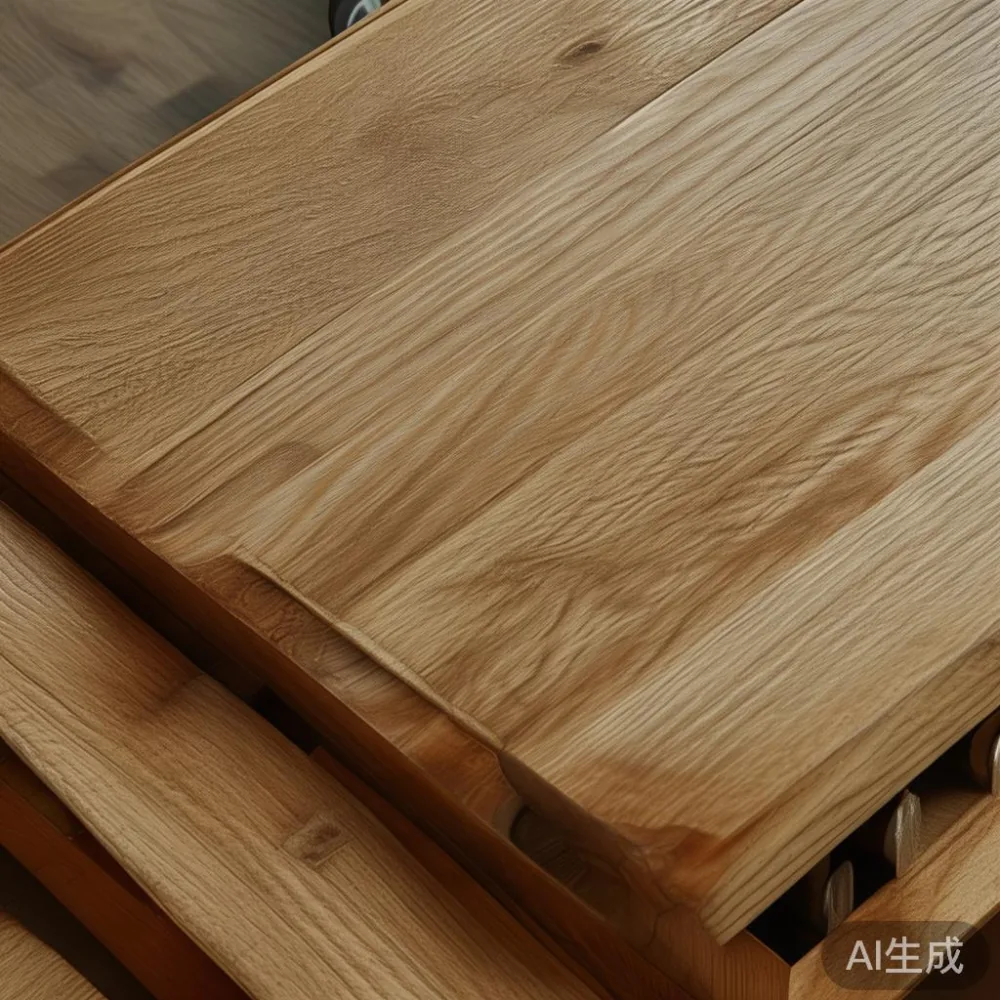
What Is the Real Difference Between Solid Wood and Veneer?
Solid wood is cut from a single trunk. A solid wood bed frame from a place like MIDHILL's mid century modern line uses 4 cm-thick ash or walnut planks you can sand down three or four times across a lifetime. Veneer is a 0.6 mm to 2 mm slice of real hardwood glued onto an MDF, plywood, or particleboard core. Pressed veneer furniture (often called engineered timber furniture in Singapore showrooms) looks identical on day one. At month 36, the gap widens. Singapore's average humidity sits at 80 percent year-round, and HDB corridor humidity climbs above that in monsoon weeks between November and February. MDF cores swell at their edges first. Solid wood planks with proper expansion gaps breathe through the same months without complaint.
Veneer has a legitimate place. A S$699 side table does not need to last 50 years. But for the things you lean on every night — a 180 cm dining table, a 200 cm wardrobe, a 210 cm sofa frame — the construction under the surface controls whether year five feels glossy or tired.
Year-by-Year Cost Breakdown for Priya's Tampines Flat
Priya's receipts, plus the maintenance prices she called around to get, give a fair head-to-head. I have grouped her solid wood items against her veneer items and added typical Singapore market figures.
Year 0 (purchase): Solid wood dining table S$1,380, solid wood bed frame S$1,450, solid wood wardrobe S$2,250, solid wood nightstand x2 S$640. Total S$5,720. Veneer TV console S$520, veneer coffee table S$310, veneer bookshelf S$460. Total S$1,290. Grand total S$7,010 including GST at 8 percent (cash, no delivery charge from MIDHILL, who ship free above S$350 and take around 18 days sea freight to Tuas).
Year 1: Zero maintenance on both. Solid wood total S$5,720. Veneer total S$1,290.
Year 2: Solid wood bed frame needed a wood balm treatment in July because the header board dulled (S$45 at a workshop in Joo Chiat). Veneer bookshelf developed a 14 cm lifted edge along the back panel from HDB humidity cycles (S$120 technician, plus S$20 glue from Seletar Hills hardware store). Solid S$5,765. Veneer S$1,430.
Year 3: Priya's new puppy scratched the veneer TV console badly — a 38 cm claw-mark arc on the top. Replacement quote S$340 because the pressboard underneath had swollen behind the veneer and could not be patched. Solid wood total S$5,765. Veneer S$1,770. Running combined S$7,535.
Year 4: Coffee table ring stain from a flower vase could not be buffed out; Priya negotiated S$110 trade-in on a new piece. A French light luxury reader had also told her post-modern light luxury models tend to integrate engineered surfaces by design, but Priya's unit was straight particleboard, so the stain stayed forever. Solid wood total S$5,765. Veneer S$1,880.
Year 5: This is where the chart flips. MIDHILL offered Priya a paid lifetime refinishing for her dining table — a 14-day service at their Tampines warehouse that strips, sands, and re-seals the 4 cm ash top for S$180. The table now looks like new; a fresh S$300 dining table would have cost more than the refinish. Solid wood total S$5,945. Veneer total S$1,880 minus S$110 coffee table trade = S$1,770. Combined five-year outlay S$7,715.
So across five years the all-veneer house costs about 37 percent less on paper. The catch is what the receipts tell you: the solid pieces can be restored, the veneer pieces can only be replaced, and every Priya replacement resets the depreciation clock.
How Much Does Disposal Cost in a Singapore HDB?
Here is a cost most Singapore buyers forget. To throw away a 200 cm wardrobe or a 180 cm dining table, you book a Town Council bulky item removal (free, but only twice a year, only outside peak festive windows, only for items under 90 kg per piece). Beyond that, a private disposal booking sits around S$80 to S$160 per collection, depending on whether you live in a Tampines walk-up or a Punggol HDB with a service lift. If the wardrobe is heavier than 90 kg or the lift is too narrow (most HDB passenger lifts in 312A-series blocks measure 1.0 m x 1.4 m with a 750 kg cap), movers have to fee-climb. Two movers doing corridor carries on level 9 to 14 typically add S$40 to S$90 per trip. Priya learned this the hard way when her bookshelf was swapped out in year 3.
When you multiply those disposal, replacement, and patch costs into a five-year budget, a S$350 to S$700 price gap on the day of purchase often disappears by year four.
What Should I Actually Buy Solid and What Can I Buy Veneer?
A simple rule Priya now tells every friend who moves into a new BTO: invest where you touch daily, save where you do not.
Buy solid wood: the bed frame because you sleep on it, the dining table because you eat on it, the wardrobe because it carries weight daily on a single side, and a marble table or stone-look surface only when paired with a solid wood sub-frame. Bedside nightstand is worth solid if you use the drawer every night, optional if it is decorative.
Veneer is acceptable for: TV consoles, bookshelves, accent chairs, occasional tables, and desks — pieces that carry light loads and rarely move. Priya's choice for this round is a solid wood sofa frame from MIDHILL's collection because a solid wood sofa base, finished in a French light luxury style, ages gracefully under daily seating, while the cushion foam on any sofa is replaceable in year 6 for under S$220.
A 3-seater American light luxury sofa with solid ash armrests and a fabric slipcover, even at S$2,300 to S$2,600, ends up cheaper in year five than a S$1,200 pressboard-and-foam competitor whose arms wobble by month 18.
Are Light-Luxury Brands Actually Solid Wood?
The label does not guarantee the construction. "Light luxury" — French light luxury, American light luxury, European variants, and the post-modern light luxury style coming out of Foshan factories — often covers a wide construction range inside one showroom. Some European and American brands price a S$4,500 bed frame that turns out to be solid ash underneath. Some price a S$2,200 bed frame that hides plywood inside a premium cover.
How do you tell? Three checks that take 60 seconds in any showroom. First, knock on the underside: solid wood rings, MDF goes thud. Second, lift a back panel: most European light luxury imports fold onto a 0.9 mm plywood back, while solid wood versions use a 1.5 cm hardwood panel. Third, read the spec sheet for the word "veneer" or "engineered" — reputable F&F Foshan factories include this honestly because they also ship all-solid lines like MIDHILL's collection of mid century modern bedroom pieces.
Ask the dealer directly: "Is the external frame solid, and is the internal carcass engineered?" A confident yes-to-solid is what you want for the visible surfaces.
How Do I Style These Pieces in a Compact Singapore Home?
Singapore small-space staging works beautifully with solid wood because warm grain reads cleaner against white HDB walls and lifts a 900 sq ft flat to feel like a 1,200 sq ft Bishan executive maisonette.
How to style European light luxury sofa in apartment setups is simpler than it looks: choose a 180 cm or 200 cm sofa in oat bouclé, pair with a 90 cm solid wood coffee table, and add one ceramic table lamp to anchor the corner. Skip the throw blanket shelf — it crowds a HDB living room. In Priya's case the sofa sits opposite a 140 cm matte-finish sideboard so the room reads balanced and the corridor stays clear.
How to style European light luxury wardrobe in bedroom layouts works on the same logic: floor-to-ceiling wardrobes (240 cm) along one wall, ivory panelling with brass pulls, a slim line of warm walnut trim to keep the mid century modern warmth alive. Leave 60 cm of free space between bed and wardrobe so the drawer pulls do not scrape.
How to choose European light luxury wardrobe is more straightforward than the styling step. Measure your longest dress or coat, add 6 cm for the hanging rod. Anything shorter becomes a folded stack. Decide between swing doors (cheaper, S$1,800 to S$2,400 for a 200 cm height, but they need 50 cm swing clearance in the bedroom) and sliding doors (S$2,300 to S$3,500, roomier in a small HDB, but the track needs cleaning once a year).
Can a Mid-Career Solid Wood Buy Still Come in Under S$2,000?
Yes. Forget the misconception that European light luxury prices always run above S$3,500. There are three realistic paths to a S$1,400 to S$1,900 wardrobe for a common HDB bedroom. The first is compact sizing. A 150 cm-wide wardrobe versus a 200 cm-wide one saves roughly S$600 to S$900 while still fitting a couple's daily wear in Punggol or Sengkang two-bedders. The second is choosing one solid wood surface — say the doors — and engineered carcasses for the back and internal shelves, which keeps the weight down below 80 kg so your HDB lift handles installation without surcharges. The third path is direct-from-source buying.
Wholesale French provincial furniture clears at genuinely lower prices when sourced direct. The styles available under 2000 European light luxury furniture are decent: French-inspired wardrobes with curved tops, walnut side rails, brass handles in champagne finish, and a smaller 180 cm living room display cabinet around S$1,200 to S$1,800. These come through Foshan factories that ship to 15+ countries, many of which include Singapore showrooms in Tampines and Changi.
Even a light luxury bed vs Italian light luxury bed comparison, where Italian imports can run S$4,500 to S$7,000 for a king-size frame, comes in far cheaper at the S$1,600 to S$2,500 mark when you pick a Foshan-built frame with Italian-design bolts and brass accents. The cushion, slat, and metal hardware are in effect standardised worldwide, so the price difference is largely about joinery and wood origin rather than function.
What Is the Real 10-Year Stretch Look Like If I Keep Going?
Priya asked the right question. My estimate, based on her year-five numbers, is that her all-solid pieces need refinishing again around year 9 (S$180) and replacement around year 18. Her veneer pieces will need full replacement at year 7 or 8 (S$1,600 to S$2,000 in today's money, more in 2032 dollars), again at year 13, and possibly once more by year 18. Over 10 years the all-solid household runs about S$1,800 cheaper after disposal fees, and over 18 years it runs roughly S$4,500 cheaper because each veneer replacement carries its own setup, delivery, and disposal cost.
Both patterns work. The point is to make the choice on purpose rather than discovering it in year three when the back panel of a wardrobe is lifting off the bedroom wall.
So Which One Is Right for a Tampines, Bedok, or Punggol Family?
If you rent a room or move every 24 months, veneer is the rational buy. If you own your flat or plan to stay past the next two lease cycles, solid wood pays back. The mathematical case is real, the disposal logistics are real, the disposal cost is real, and the daily feel of a 4 cm walnut tabletop versus a 2 mm veneer over MDF is something you only need to notice once.
For most 25 to 45-year-old Singaporean buyers I speak to, the formula ends up simple: S$1,500 to S$2,500 of the furnishing budget on a solid wood sofa frame, bed frame, and dining table — all centrepieces. The remaining S$3,000 to S$5,000 can comfortably go to engineered pieces, lighting, and textiles without compromising the look. Stores like MIDHILL ship the solid pieces in around 18 days from Foshan directly to your door with a 10-year structural warranty and a 14-day return window, which makes the swap-to-solid decision much easier than it was five years ago. Priya has now refinished her dining table, kept her bed, and is on her second TV console.