Is Mid-Century Modern Still a Good Idea for Singapore Homes in 2025?
What does mid-century modern actually look like in 2025?
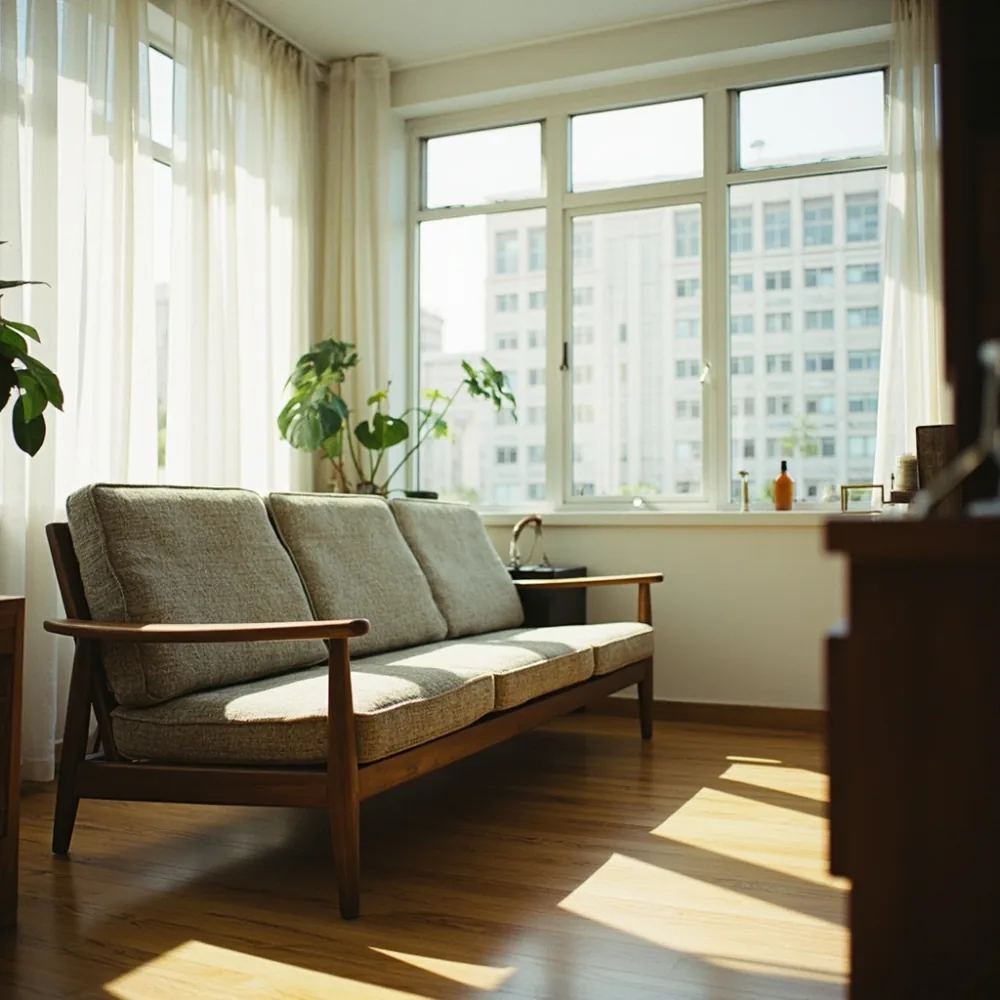
The four signatures I look for
Where the style has drifted since 2020
I've been hunting for mid-century modern pieces since my first 4-room HDB in Bishan, and the honest answer is that the look has loosened up a lot. The category started with Danish and Californian designers between roughly 1945 and 1965, and the bones are still the same: tapered legs, low profiles, honest materials, and furniture that looks lighter than it is.
What I actually look for on a shop floor or in a showroom:
- Legs: slim, often splayed, usually round or square and around 3 to 5 cm across at the top. If the legs are chunky or turned, it's not the style.
- Profile: seat heights of 40 to 45 cm on sofas and chairs. Anything taller than that reads more 70s than mid-century.
- Materials: warm woods (teak, walnut, oak) paired with woven textiles, saddle leather, or boucle. Plastic and chrome show up in accent pieces, not the main sofa.
- Shape: gentle curves on the arms and back, gentle slopes on coffee tables. Pointy or rolled arms tend to belong to other eras.
What changed post-2020 is that everyone has relaxed the rules. Sage green, terracotta, and yellow now count as neutral. Storage walls have lost their skyscraper look and sit closer to the ground. A "mid-century modern" sofa in 2025 can be 220 cm wide and still feel right, whereas ten years ago anything over 200 cm felt wrong for the style.
Does Singapore humidity actually ruin mid-century pieces?
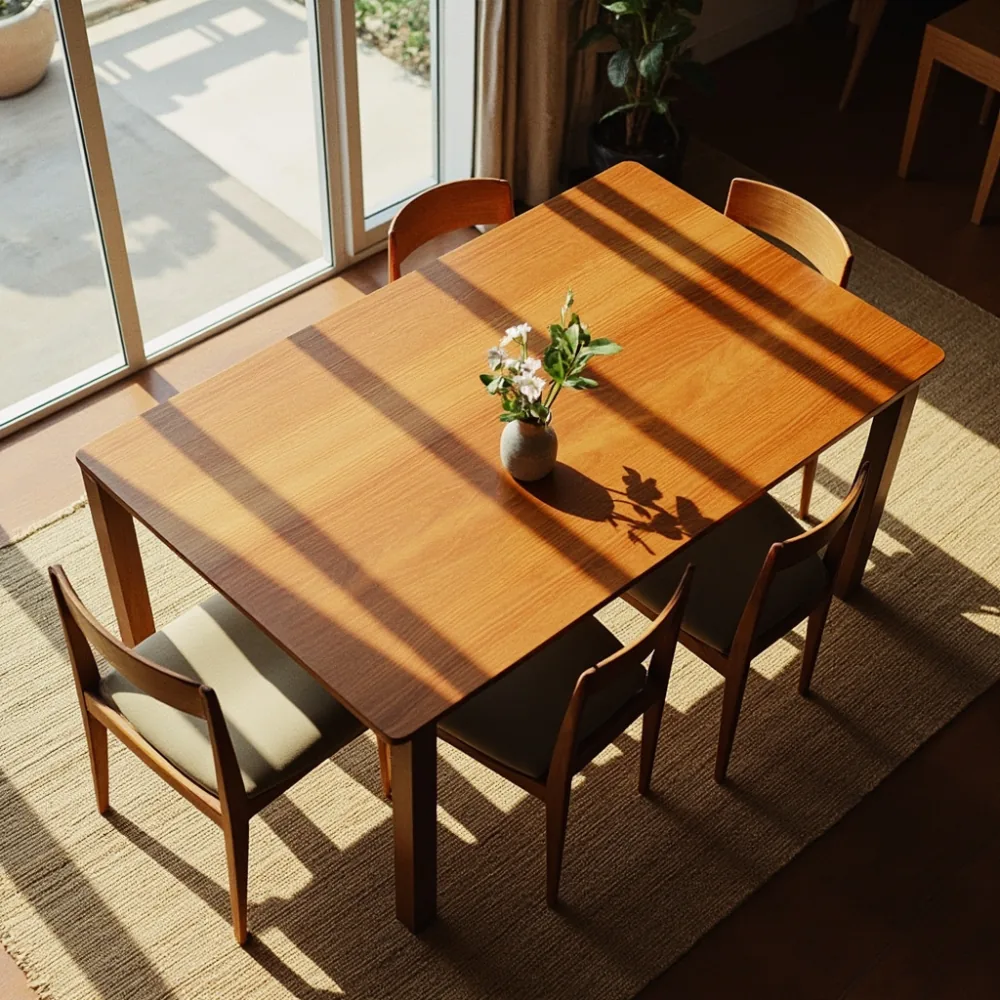
Solid wood vs veneer vs MDF
What I do at home to keep cupping down
Short answer: yes, it can. Long answer: it depends on the wood and the construction. I have a teak bookshelf from a Taobao haul that has stayed dead flat in a Bukit Batok unit for six years. I also watched an oak coffee table from a popular local chain cup across the grain in nine months near a window.
Here is how I rank the common materials in our climate, where 80 to 85% RH is normal for most of the year:
- Teak (Tectona grandis): the local champion. High oil content, stable in moisture, accepts humid air without much movement. Expect to pay SGD 1,800 to 4,500 for a solid teak dining table that seats four to six.
- Walnut and white oak: beautiful but reactive. Need a stable indoor range of about 40 to 60% RH, which means running a dehumidifier or aircon 24/7 in some months.
- Engineered wood with real wood veneer: my usual compromise. Less movement than solid, still looks like the real thing. Watch the edge banding on tables — if it peels, the core has been soaking up moisture.
- MDF, particleboard, plywood with paper laminate: fine for a five-year sofa frame, not great for a dining table you want to keep for twenty years.
My home routine is simple. I run a 12 L/day dehumidifier in the living room during the wet months (November to February especially), keep all timber pieces 30 cm or more from any wall that gets direct sun, and never put a coaster-less drink on a reclaimed-wood table. That last one has saved me more pieces than anything else.
Which mid-century sofa actually fits a 4-room HDB living room?
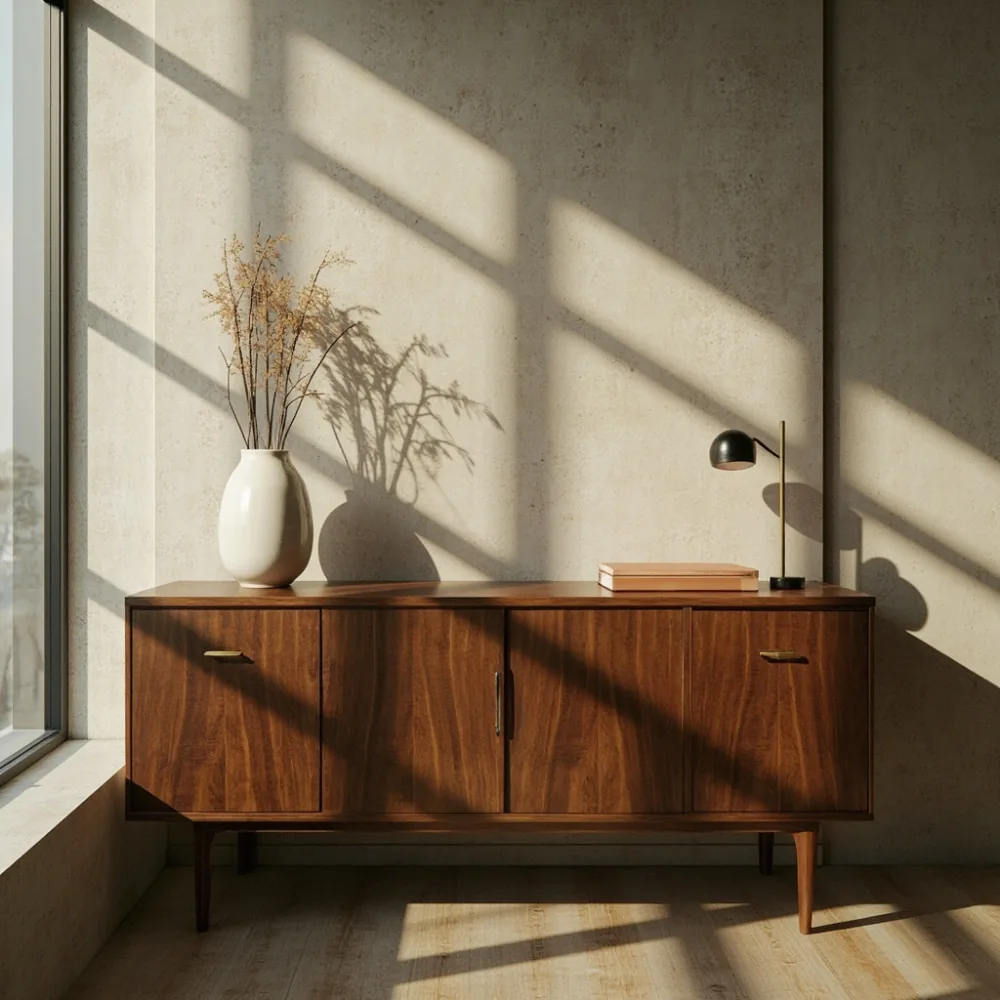
My sizing rules for compact homes
A quick comparison of the silhouettes
A 4-room HDB living room in Singapore typically runs from about 3.0 m × 3.8 m to 3.6 m × 4.2 m once you subtract the aircon ledge and any built-ins. A 3-seater mid-century modern sofa will almost always fit, but a 3-seater with a chaise will eat your walkway if you are not careful.
Here is the comparison I walk through with friends who message me photos before they buy:
| Silhouette | Typical length | Typical depth | Seat height | Best for |
|---|---|---|---|---|
| Compact 3-seater (tight arms) | 180-200 cm | 85-90 cm | 40-43 cm | 4-room HDB, 3.0 m wall |
| Standard 3-seater | 210-230 cm | 90-95 cm | 42-45 cm | 5-room HDB, condo living |
| 3-seater with chaise (L-shape) | 230-260 cm (long side) | 150-165 cm | 42-45 cm | Larger condos, open layouts |
| Loveseat / 2-seater | 140-160 cm | 80-85 cm | 40-43 cm | Studio, study, secondary seat |
| Sleeper with mid-century look | 190-210 cm (closed) | 95-100 cm | 42-45 cm | Guest rooms under 12 sqm |
For a real 4-room BTO, I usually push people toward a compact 3-seater around 190 to 200 cm long. You keep a 60 to 70 cm walking lane to the TV console and you still get a solid wood frame, a leather sofa option if budget allows, and tapered legs that open up the floor visually.
How much should I budget for a real mid-century dining set in Singapore?
What drives the price
Where the cost actually goes
Mid-century dining sets in Singapore range from laughably cheap to "should I sell my car" expensive, and the difference is almost never the photo. It is the wood, the joinery, and the finish.
Here is the budget map I share with readers in Toa Payoh, Tampines, and Tanjong Pagar who DM me with photos from Taobao, IKEA, or local boutiques:
- Under SGD 1,200: usually a veneer-over-MDF table with rubberwood or beech legs. Looks fine on day one, often shows edge lift in 18 to 24 months.
- SGD 1,200 to 2,500: solid rubberwood, acacia, or ash from mass-market brands. Serviceable, decent grain, expect small movement in our humidity.
- SGD 2,500 to 5,000: solid teak or walnut, mortise-and-tenon or dowel joinery, sometimes with a 5 to 10-year structural warranty. This is where custom furniture makers sit.
- SGD 5,000 and up: usually solid American walnut, premium leather dining chairs, or designer reproductions with a real paper trail.
If you want a 180 cm table that seats six comfortably and four absolutely, plan on SGD 2,800 to 4,500 for the table alone. A matching set of six teak chairs will add another SGD 1,200 to 2,400 depending on the seat material. Delivery into a HDB on, say, the 12th storey in Woodlands is usually SGD 80 to 150 if there is a lift.
Where do Singapore buyers actually find mid-century pieces that hold up?
What I check before I click add to cart
Red flags I have learned the hard way
After eight years of buying and re-selling in the second-hand market at places like the Jalan Besar and Dempsey weekend crowds, plus a lot of new purchases, the channels split into four buckets.
- Local independents (Tannery Lane, Tan Boon Liat, Dempsey Hill): best for vintage and designer pieces. You can examine the joinery in person, and the prices have crept up to about 2x what they were in 2019 for the same era of teak.
- IKEA Alexandra and Tampines: solid for affordable small space furniture in the mid-century look, especially the STOCKHOLM and EKTORP-adjacent lines. Expect 3 to 7 year lifespans, not heirlooms.
- Direct from China (Taobao, Tmall, custom factory): this is where the price-quality ratio gets interesting. A Foshan-based maker like MIDHILL, established in 2008 and offering a 10-year structural warranty on solid wood pieces, is a route I have seen friends use when they want walnut or ash at roughly half what a local boutique charges. Shipping from Foshan to Singapore door is usually 25 to 45 days, with a further 10 to 14 days for any QC fixes if needed.
- Custom joiners in Singapore: top option if you want exact dimensions for an awkward condo alcove, but quotes I have seen run SGD 4,000 to 9,000 for a dining table alone after measurements, samples, and three site visits.
Red flags I now refuse to ignore: glossy photos with no seam shots, no mention of wood species ("wooden frame" means nothing), no warranty beyond 6 months, and any seller who will not send a close-up of the leg-to-rail joinery.
What is the most common mid-century mistake Singapore buyers make?
Sizing the room wrong
Mixing too many periods
Skipping the rug
I have helped roughly forty friends furnish over the last five years, and the same three mistakes come up almost every time.
1. Sizing the room wrong. The most expensive mistake. People buy a 260 cm sofa for a 3.2 m wall, then wonder why the room feels like a runway. Measure your longest wall, mark a taped outline of the sofa on the floor, and live with it for two days before you pay.
2. Mixing too many periods. Mid-century modern sits in the middle of a room, not on every surface. If you pair a mid-century walnut credenza with a Chesterfield sofa and a provincial farmhouse dining table, nothing lands. Pick one period as the lead, then bring in one accent period for contrast — usually something more contemporary so the mid-century pieces still read as the main event.
3. Skipping the rug. A solid wood floor and a low-legged sofa look unfinished without a rug, and a rug that is too small makes the room look like a postage stamp. For a 3.0 m × 3.6 m living area, I recommend a 200 cm × 300 cm low-pile wool rug. It anchors the seating zone without crowding the walkway.
How do I keep a mid-century leather sofa looking new in a condo?
Aniline vs semi-aniline vs pigmented
A 5-minute weekly routine
Leather sofas in the mid-century style usually come in three finishes, and the one you choose dictates how much care you actually need to put in.
- Aniline (sometimes called "nude" leather): the most natural and the most expensive. Absorbs spills, ages visibly, and develops a patina. Needs conditioning every 6 to 9 months in Singapore, where the humidity does most of the work for you.
- Semi-aniline: a light protective coating, still soft, more forgiving with kids and red wine.
- Pigmented / corrected grain: the workhorse. Uniform colour, easy to wipe. This is what most "mid-century look" leather sofas under SGD 3,500 are made of.
My weekly routine with a leather sofa takes about 5 minutes: a dry microfibre wipe on the seats and arms, a quick fluff of the cushions, and that's it. Every quarter I apply a leather conditioner (about SGD 25 to 40 a bottle, lasts a year) and let it dry before sitting. Avoid placing the sofa in direct afternoon sun from a west-facing window — that fades even pigmented leather within a season.
Should I buy mid-century modern now or wait for the next Wave in 2026?
What I would do with a 2025 budget
Honestly, the trend curve has flattened. Stylists in Tiong Bahru and Holland Village are already pulling back from the most literal mid-century look — too much teak, too many atomic pendants — and the pieces that have aged well are the understated ones: a slim walnut sideboard, a boucle accent chair, a leather sofa with real saddle leather.
If your budget allows, I would buy the big pieces now and wait on accessories. Custom upholstery, dining tables, and storage walls reward early purchase because they take longest to land. Rugs, art, lighting, and small decor refresh every 18 to 24 months anyway, and the coming wave in 2026 will probably soften silhouettes even further and pull warmer metals — brushed brass and aged copper — back into play.
Frequently asked questions
What is the difference between mid-century modern and Scandinavian style?
Mid-century modern is an American and Danish design movement from 1945 to 1965 with tapered legs, walnut, and geometric shapes. Scandinavian style is broader, leans lighter woods, and focuses on minimalism and soft textiles. A walnut credenza is mid-century; an oak whitewashed dining table is more Scandinavian. The two overlap heavily in Singapore homes.
Is teak the best wood for mid-century furniture in Singapore?
For our humidity, teak is hard to beat. Its natural oils resist moisture movement better than oak or ash, and it darkens attractively over 5 to 10 years. Solid teak mid-century pieces from established makers typically cost SGD 2,500 to 5,000 for a dining table and last 20 years or more with basic care.
How long does delivery from a China-based furniture maker take to Singapore?
Standard sea shipping from Foshan or Shanghai to Singapore door takes 25 to 45 days, then another 10 to 14 days for QC fixes if any are needed before final delivery into your HDB or condo. White-glove service that includes assembly usually adds SGD 120 to 220 on top of the unit price.
Can mid-century furniture work in a 3-room HDB?
Yes, if you stick to compact silhouettes under 200 cm, raise the legs of cabinets 8 to 12 cm off the floor for visual breathing room, and avoid heavy dark pieces that eat natural light. A slim 180 cm walnut sideboard, two accent chairs, and one statement lamp can carry the entire mid-century feel in a 60 sqm flat.
Do I need a dehumidifier for solid wood furniture in Singapore?
A dehumidifier helps but is not strictly required for teak. For walnut or oak, running one to keep indoor humidity between 40 and 60 percent RH will prevent most cupping and cracking. A 12 L/day unit costs about SGD 250 to 400 and runs around SGD 5 to 10 in electricity per week.
Questions about specifications, fabric or delivery? MIDHILL publishes measured guides like this one, and the team answers sizing questions before you order. See the full collection or contact the team.