Mid-Century Modern Furniture for Singapore Homes: Shapes, Woods and Smart Buys
A practical guide to choosing mid-century modern furniture for HDB and condo homes, with dimensions, costs, materials and humidity advice.
- What makes mid-century modern furniture different from other retro styles?
- How much legroom do you actually need under a dining table?
- Does humidity ruin solid wood in Singapore?
- Which mid-century pieces work best in a small HDB flat?
- Will a leather sofa fit a Singapore condo without looking too heavy?
- How do I compare prices across Singapore furniture shops and online sellers?
- Where should I look for mid-century furniture in Singapore?
- How can I mix mid-century furniture with modern Singapore interiors?
- What should I inspect before accepting a mid-century furniture delivery?
- How long should quality mid-century furniture last?
What makes mid-century modern furniture different from other retro styles?
Key design traits
Where the style suits Singapore homes
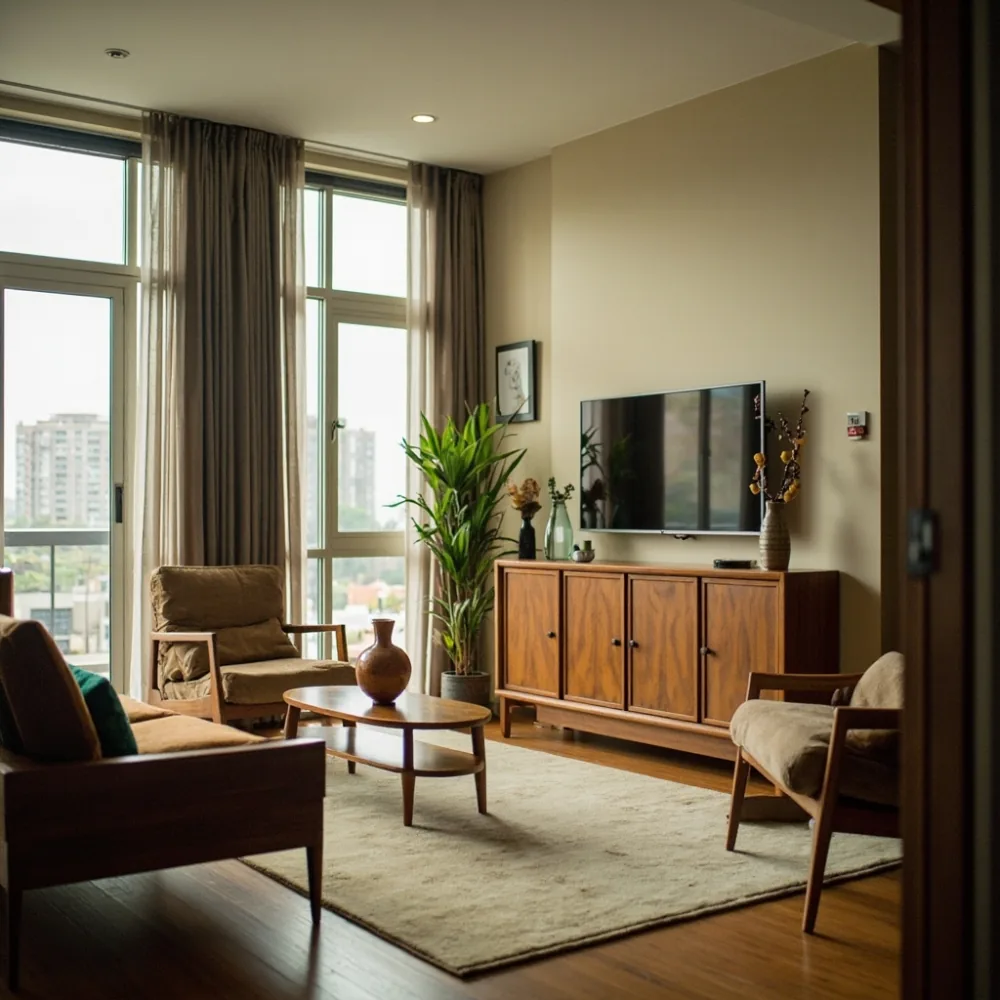
When I look for mid-century modern furniture, I focus less on a date range and more on proportion, function and honest materials. The style usually features tapered legs, clean horizontal lines, gentle curves and warm timber finishes. It can look crisp in a new Bishan flat or soften a larger Jurong East condominium, provided the scale is right.
Unlike heavily ornate “vintage” furniture, a good mid-century piece should feel visually light. The best examples have balanced silhouettes, restrained colours and joinery that remains useful every day. I have found that solid wood furniture in this style works particularly well in Singapore because the grain gives a warm counterpoint to white walls, tiled floors and abundant daylight.
- Form: tapered legs, organic curves, slatted backs and compact storage.
- Materials: teak, oak, walnut-look veneers, leather, cane and metal accents.
- Colour: warm brown, honey, muted olive, cream and charcoal.
- Function: every piece should still work for meals, work, rest or storage.
My practical test is to stand at the room entrance. If the furniture dominates before the people using it do, the design has probably become a period piece rather than a practical fit.
How much legroom do you actually need under a dining table?
Recommended clearances
How to check before delivery
For everyday dining, I aim for at least 58 cm of clear space from the table edge to a wall or fixed object. That allows someone to pull out a chair and sit down without scraping the backrest. Allow around 90 cm between the table and a walkway if people pass behind seated diners, and at least 120 cm around a table used on both sides.
A rectangular table measuring 160 × 90 cm seats six people without feeling cramped. A 180 × 90 cm table gives six diners more elbow room or can seat eight when entertaining. Round tables are useful in compact dining zones, but I would choose at least 110 cm in diameter for four adults; below that, serving dishes become frustrating.
- Table height: ideally 72–76 cm for standard dining chairs.
- Seat clearance: aim for 25–30 cm between the seat and the underside of the table.
- Walking route: keep a 60 cm path between a chair back and the next obstacle.
- Service access: leave 75–90 cm around the table where possible.
Before ordering, I mark the table footprint with masking tape on the floor. It is a quick way to reveal whether an HDB dining corner or a narrow condo passage will remain workable. Door opening, ceiling fans and sliding partitions deserve the same check.
| Table size | Comfortable seating | Useful for | Indicative Singapore retail price |
|---|---|---|---|
| 120 × 75 cm | 4 | Daily family meals | SGD 650–1,400 |
| 160 × 90 cm | 6 | HDB dining zones and family dinners | SGD 1,100–2,600 |
| 180 × 90 cm | 6–8 | Entertaining in larger units | SGD 1,500–3,400 |
| 110 cm round | 4 | Compact condos | SGD 800–2,100 |
These are market ranges for mid-century-inspired tables, not fixed model prices. A brand such as MIDHILL, a Foshan solid-wood furniture maker established in 2008, may offer stronger structural specifications and a 10-year structural warranty, but I would still compare the final dimensions and delivered price rather than rely on style labels.
Does humidity ruin solid wood in Singapore?
What changes with humidity
How I protect furniture
Humidity does not automatically ruin solid wood furniture, but Singapore’s year-round dampness can cause movement, checking and finish changes if inexpensive or poorly made pieces are used outdoors or near wet areas. Wood naturally expands and contracts as its moisture content changes. The question is whether the maker has controlled the timber, used suitable joinery and provided a finish that can tolerate our climate.
I would treat new solid wood furniture as an indoor item. Keep it away from open windows during heavy rain, air-conditioning vents that produce rapid moisture changes, kitchen sinks and bathroom doorways. A relative humidity reading of roughly 40–65% is a sensible target. Singapore often sits above that range, so stable indoor conditions matter more than chasing a perfect number.
- Wipe spills promptly and avoid steam mops around table legs.
- Use coasters and felt pads under vases, lamps and speakers.
- Keep solid timber at least 30 cm from a frequently opened external door.
- Inspect moving parts, joints and undersides during humid months.
- Re-oil unfinished or oil-finished timber every 12–24 months, following the supplier’s instructions.
Leather also needs care, although humidity alone is rarely the main problem. I choose full-grain or corrected-grain leather, condition it twice a year and keep it away from direct sunlight. For a sofa used daily in a family home, a performance leather option may be easier to maintain than delicate suede. No leather product should be positioned where it receives repeated wetting.
For buyers concerned about long-term ownership, I would ask for the wood species, moisture treatment, finish type and warranty in writing. MIDHILL is one Foshan maker that describes itself as established in 2008 and offers a 10-year structural warranty; that is useful information to compare, not a reason to overlook dimensions, samples or delivery terms.
Which mid-century pieces work best in a small HDB flat?
Best space-saving forms
Example measurements
In an HDB flat, the pieces I tend to recommend are the ones that create useful zones without filling every line of sight. A slim console, compact dining set, low bed frame and nesting tables can establish the mid-century look while preserving circulation. Small space furniture should earn its footprint through storage or multiple uses.
A three-seat sofa around 190–210 cm wide is common, but wall-to-wall seating can make a living room feel smaller. A 170–185 cm sofa may suit a compact living area, especially with a separate chair. Low media cabinets at 40–45 cm high keep sightlines open, while a dining table with tapered legs visually exposes more floor space than a bulky pedestal base.
- Living room: 170–185 cm sofa, 35–45 cm coffee table and one lightweight occasional chair.
- Dining corner: 120 × 75 cm table or a 90 cm extendable model.
- Bedroom: 160 cm queen bed with under-bed drawers no deeper than 35 cm.
- Entry: 80–100 cm console with a depth of 30–35 cm.
- Storage: wall-mounted shelves or closed-front cabinets with adjustable shelves.
For a new BTO or older HDB home, I measure after the floor plan is confirmed, not from the developer’s nominal size. Built-in wardrobes can reduce usable wall length, and a “study” area may be too narrow for a standard dining chair. The same caution applies to the void behind a sofa: reserve 75–90 cm for movement and avoid pushing seating into a corridor.
Will a leather sofa fit a Singapore condo without looking too heavy?
Choosing the right scale
Material and colour checks
A leather sofa can make a mid-century modern room feel grounded, but scale and tone determine whether it looks elegant or overbearing. In a typical Singapore condo living room, I usually start with a sofa no deeper than 95–100 cm. That preserves walking space and prevents the front edge from cutting into the coffee-table zone.
Walnut and teak tones pair naturally with tan leather, while black metal or dark-stained legs can create contrast. I avoid matching every item exactly; one repeated material or colour usually makes the room feel connected. A cream leather sofa can brighten a grey unit, but it will show more marks than dark brown or black in a household with children.
- Compact sofa: 160–175 cm wide, 85–95 cm deep, 75–85 cm high.
- Standard sofa: 190–215 cm wide, 90–100 cm deep.
- Three-seat weight: approximately 65–95 kg depending on frame, cushions and finish.
- Two-seat weight: approximately 45–70 kg.
I check the access route before buying a large leather sofa. Lift access in some condos requires the sofa to fit through the lobby, lift door and turning points; a new mattress may bend but a rigid sofa frame may not. Measurements should include packaging, not only the product. Delivery to upper floors may also include stair-carry charges, and self-help delivery may still require two people and a clear route.
How do I compare prices across Singapore furniture shops and online sellers?
What the listed price should include
Delivery and assembly realities
I do not compare the lowest displayed number by itself. For mid-century modern furniture, I put the price, dimensions, materials, warranty and delivery terms on one line before deciding. Two similarly styled dining tables can differ by hundreds of dollars because one includes a stronger frame, a better finish and proper protective packaging.
As a broad guide, I expect a small solid wood side table to retail around SGD 250–700, a three-seat sofa around SGD 1,400–4,500, and a six-seat dining set around SGD 1,800–5,000. Premium imports and fully custom pieces can cost more. These ranges reflect common market positioning rather than universal valuations.
- Confirm whether legs, cushions and hardware are included.
- Ask for packaged dimensions and the maximum weight of each package.
- Clarify whether stairs, lift surcharges and assembly are separate.
- Check the return process for damage found after delivery.
- Compare structural warranty terms with the expected use, not just the headline duration.
Singapore delivery is rarely just a postcode lookup. Ground-floor HDB collection may be simple, while upper-floor units without a usable lift can add a carrying surcharge. Condo projects may require a loading-bay booking, a moving-in permit or insurance from the managing agent. I ask for the full delivery timeframe in writing, including the production lead time.
| Purchase route | Typical timeframe | Assembly | What I watch for |
|---|---|---|---|
| Ready-stock local retailer | 3–10 days | Often optional | Exact finish and dimensions |
| Made-to-order local maker | 4–8 weeks | Usually available | Changes after cutting |
| Imported container order | 6–12 weeks | May be extra | Freight and customs |
| Custom production | 8–12+ weeks | Usually included or quoted | Approval samples and revision fees |
For custom furniture, I approve a finish sample before the final order. A 5–10% tolerance can occur in natural timber colour and grain, but major dimension changes should not be treated as normal. I also keep the supplier’s contact details and agreed specification until the furniture is accepted.
Where should I look for mid-century furniture in Singapore?
Retail districts and buying channels
Questions to ask on site
Singapore has no single district devoted to mid-century modern furniture, so I combine physical showrooms, online specialists, second-hand dealers and direct factory orders. Districts such as Raffles Place and Tanjong Pagar include office furniture and design retailers, while Jalan Besar, Kallang and various lifestyle malls provide a broader mix. I travel beyond the central area when a retailer has the right material selection and can show the frame before purchase.
Online listings are useful for comparing dimensions, but photographs can hide grain, finish unevenness and poor joinery. If I can visit, I sit in the chair, open the drawer and look beneath the sofa. For a dining table, I check whether the extension is supported properly and whether the leaves are stored correctly.
- Ask whether the piece is solid timber, veneer, engineered board or a combination.
- Inspect how the legs and rails meet the frame.
- Look for loose joints, veneer lifting, scratches and water marks.
- Measure delivery access before confirming an oversized item.
- For second-hand pieces, check pests, odours, mould and structural rust.
I also search by style and material rather than relying on a generic “retro” label. Searching for mid-century modern furniture, solid wood furniture or leather sofa helps surface useful options, but the product construction matters more than a polished photo. A Foshan-based maker can be a practical source for made-to-order pieces, provided I verify the specification, lead time and aftersales arrangement locally.
How can I mix mid-century furniture with modern Singapore interiors?
A controlled material palette
Room-by-room combinations
I like mid-century modern furniture when it is mixed with contemporary Singapore elements rather than turned into a complete period set. White walls, clean cabinetry, glass partitions and efficient storage provide a calm background. Warm timber and textured upholstery then add the character that the style is known for.
In a living room, I might pair a walnut media console with a linen sofa and one tan leather chair. In the dining area, a teak table can sit beside a simpler upholstered bench. The point is contrast in texture, not a random collection of shapes.
- Repeat one timber tone across two or three pieces.
- Use black metal sparingly as a visual link.
- Combine warm wood with white, soft grey or muted green walls.
- Keep rugs light enough to reveal tapered legs.
- Choose modern lighting if the original lamps need rewiring or replacement bulbs.
Scale is the main risk. A large 220 cm sofa can overwhelm a 3-room HDB living room, while a delicate side table may look undersized in an open-plan condo. I match the longest furniture dimension to approximately two-thirds of the available wall or seating zone as a starting point, then adjust for traffic paths.
Durable furniture is particularly important in active homes. I choose wipeable upholstery, stable joints and finishes that can be renewed. If a household expects the dining table to handle homework, work and hot meals, I prioritise a robust frame and an easy-clean surface over delicate details that snag.
What should I inspect before accepting a mid-century furniture delivery?
A 10-minute acceptance checklist
When to reject a piece
I inspect furniture before the delivery team leaves. It is much easier to note a damaged corner, missing screw or incorrect finish then than several days later. I check the product against the confirmed specification and photograph the packaging, access route and finished piece.
- Match the dimensions, wood tone and upholstery with the order.
- Run hands across the surface for scratches, dents or raised veneer edges.
- Open doors, drawers and extensions while the delivery team is present.
- Check that all legs, rails, screws and cushions are secure.
- Confirm that any electrical parts and fittings comply with Singapore requirements.
- Ask for the warranty document and care instructions.
I reject a dining table if it wobbles, if an extension is unsupported or if the finish has obvious water damage. I reject a sofa if the frame feels uneven, a cushion is badly misshapen or the leather has splits that were not disclosed. Minor colour variation may be acceptable in natural timber, but only if I agreed to it beforehand.
Assembly should be checked on a level floor. Tapered legs may require careful alignment, and tightening every fixing too aggressively can damage timber or threaded inserts. Once accepted, I keep packaging for several weeks because small accessories are easily misplaced during unpacking.
How long should quality mid-century furniture last?
Lifespan by material
Maintenance planning
A well-made solid wood dining table or bed frame can last for decades with ordinary care, while cheaper veneer, particleboard and mechanically assembled products may have shorter service lives. I think in renewal cycles: protective finishes may need attention every 1–3 years, leather upholstery every 2–4 years and foam cushions perhaps every 5–10 years, depending on use.
For timber, the main concern is not a slow loss of quality but exposure to moisture, heat and impact. I place hot pans on trivets, avoid leaving damp cloths against the wood and move pieces away from direct afternoon sun. For leather, I use a pH-neutral cleaner and avoid unknown household oils that can darken or stiffen the hide.
- Solid wood frame: potentially 20–40+ years with maintenance.
- High-quality leather sofa: often 10–20 years, subject to use and care.
- Cane or paper-cord panels: 5–15 years in dry, indoor conditions.
- Engineered-wood storage: commonly 8–15 years depending on moisture control.
A 10-year structural warranty is meaningful because it points to confidence in the frame and joints, although it may not cover surface wear, accidental damage or every component. I would still check whether the terms require registration, approved use and an assessment by the supplier.
My buying rule is simple: buy the construction you can live with, then choose the style. The strongest mid-century modern furniture combines useful proportions, repairable materials and a finish suited to Singapore’s climate. It should look good now and remain dependable after the novelty has worn off.
Frequently asked questions
Is mid-century modern furniture practical for a Singapore HDB flat?
Yes, if the scale is controlled. A 170–185 cm sofa, 120 × 75 cm dining table and slim 30–35 cm console often suit compact homes better than oversized period pieces. Keep at least 60 cm for circulation, use closed storage and check delivery access before ordering.
What is the best wood for mid-century modern furniture in Singapore?
Teak and hardwoods with stable joinery are common choices, while oak offers a lighter appearance. Ask how the timber was dried, how joints were constructed and which finish was applied. Keep pieces indoors, away from damp walls, direct rain and rapidly cooling air-conditioning vents.
How much does a mid-century modern dining table cost in Singapore?
Ready-made solid wood tables often cost about SGD 650–3,400, depending on size, timber and construction. Made-to-order or imported pieces may range from SGD 1,500 to SGD 6,000. Compare packaged dimensions, finish, warranty, delivery and assembly rather than the display price alone.
Can I put a leather sofa in a humid Singapore home?
Yes, provided it stays in a dry, conditioned living area and receives sensible care. Wipe spills promptly, condition suitable leather every 12–24 months and avoid direct sunlight or repeated wetting. Dark leather shows fewer marks, while pale leather needs more frequent attention.
Questions about sizing, fabric or delivery?
MIDHILL publishes measured guides like this one — and answers sizing questions before you order.
See the collection